
Inside Dominic West and Catherine Fitzgerald's gloriously quirky garden in rural Wiltshire

How, as a landscape designer, do you let go of the disciplines you have adhered to for many years to create your own, less formal domain? This was the challenge faced by Catherine FitzGerald when she moved to a former Victorian brewery in rural Wiltshire in 2018 with her husband, actor Dominic West and their four children. Catherine’s masterplan for her own garden was to respond to the spirit of the place.
The previous owners had lovingly cared for the house and garden for over 50 years, but Catherine was keen to create something atmospheric among the quirky spaces that lay between the ancient cottage on the lane and the adjoining brewery building. Set in the middle of a Cotswold village dotted with old mills, she wanted it to look as if it had always been there: whimsical Arts and Crafts topiary, roses and clematis on hazel structures, giant cardoons – nothing too ‘imposed’. ‘I wanted it to be relaxed – a place of experimentation and change, where random plant associations and self-seeding could happen without it mattering,’ she says.
With its thin, free-draining and brashy soil, it is a far cry from Catherine’s family home at Glin Castle, in County Limerick on the west coast of Ireland, where she grew up and has now taken over the garden. There, the soil is heavy clay and acidic, and the Gulf Stream climate is mild and damp. ‘It has been quite a tussle to grow some of the plants I love, such as the roses, in what was essentially once a brewery yard. The ground was hard and compacted, and needed lots of manure and compost to build it up.’
Catherine, who worked for Arabella Lennox-Boyd before setting up on her own, has collaborated with the landscape architect Mark Lutyens for 20 years and recently joined forces more formally as Lutyens & FitzGerald Landscape Design. Inspiration has also come from designer, writer and neighbour Mary Keen, who has been making a new garden nearby: ‘Of course, the overall design is important to Mary but I love the way she values her “treasures” – her favourite plants – above all else. The plants are what matter. Any day of the year, even in early January, her courtyard pot collection will be sparkling with jewels to be admired close up and the succession continues through every month.’
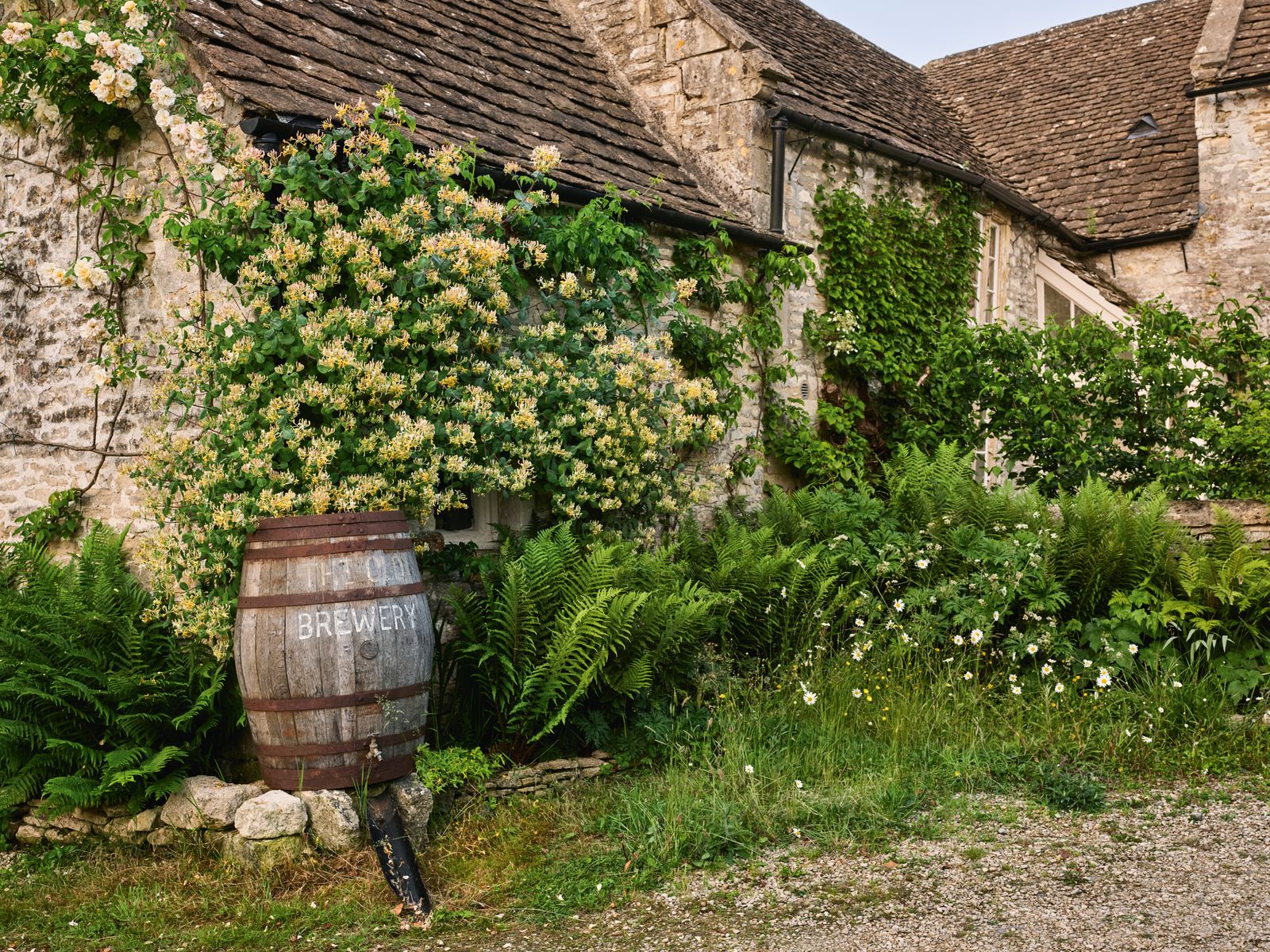
Black Labrador Whiskey likes to sun himself in the lane at the front of the house, where passing cars are few and far between. Walkers can peer into the front garden – it starts with spring hellebores, snowdrops and the delicate tiny yellow stars of Cornus mas, which flowers from the bare stems. Then it’s the spicy-scented viburnum with its plump, pale pink flowers in March, and pear blossom. Summer brings a tumble of roses, clematis scrambling up wigwams, honeysuckles full of bees, clouds of milky bellflower, pale yellow thalictrum and lilies crammed between the yew topiary – all tall enough to be seen over the wall. The Hungarian daisy, Leucanthemella serotina, brought back from a visit to Gravetye Manor in West Sussex, marries with self-seeders like ox-eye daisies, valerian and cow parsley. A shady verge of lush green ferns is enlivened with spots
of orange crocosmia (a favourite plant, which abounds at Glin), softening the boundary between garden and lane.
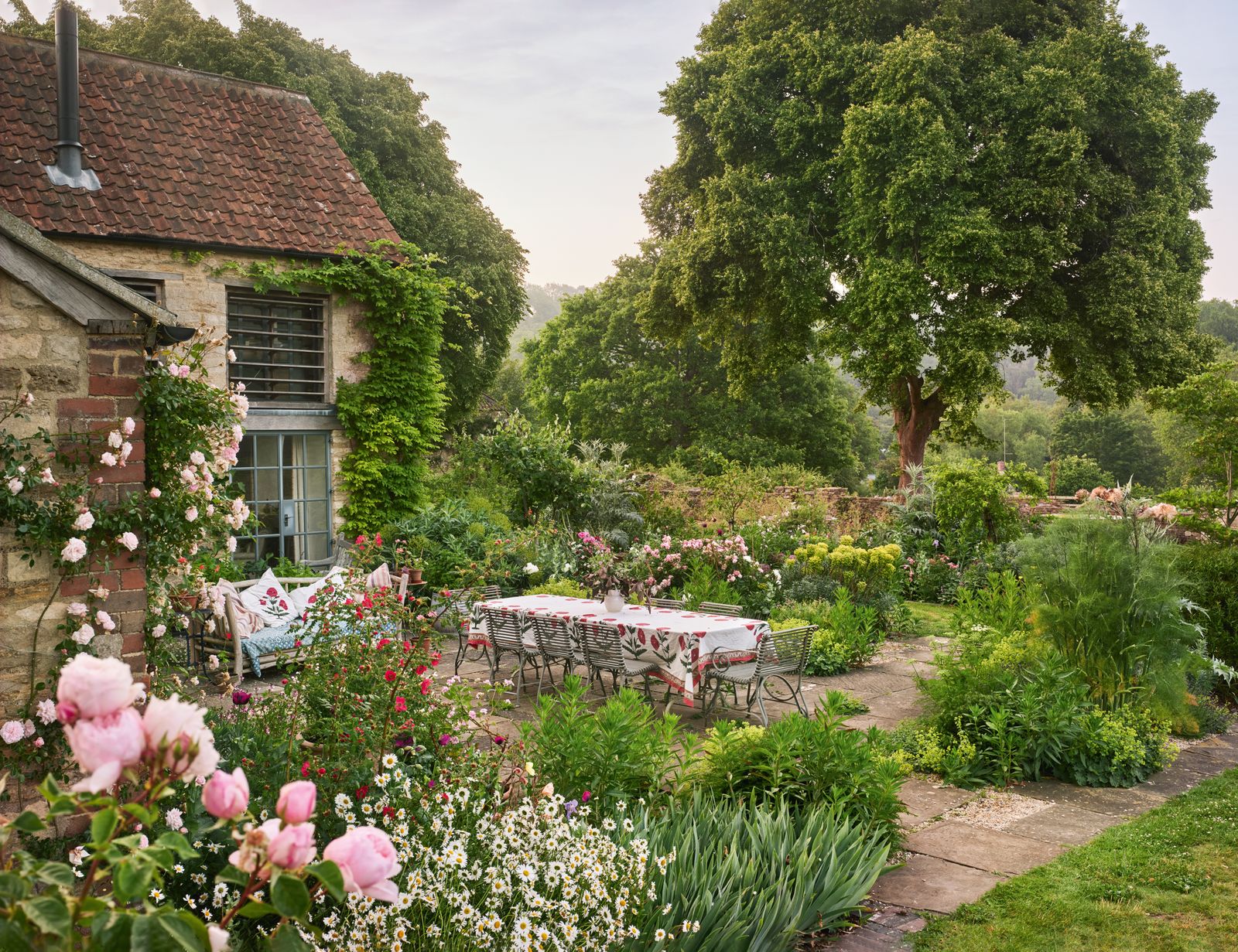
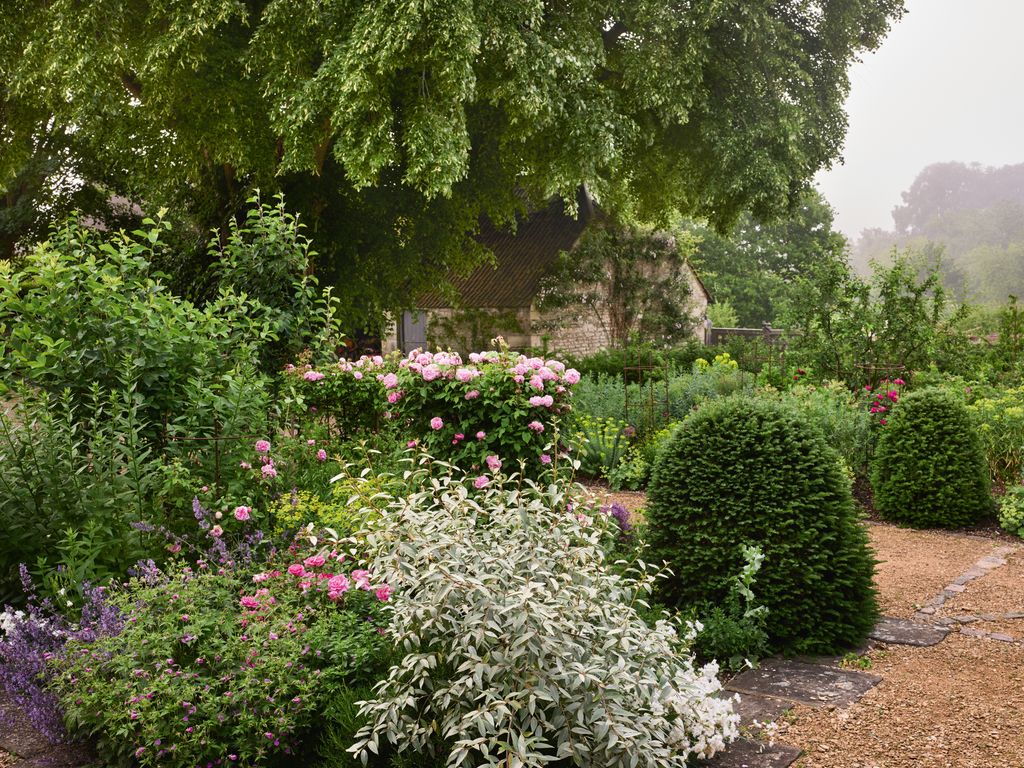
Through the gates, however, is the family’s territory. The Victorian working buildings, with a tall brick chimney and louvred ventilation windows, introduce a note of industrial grit to the Cotswold charm of the stone 18th-century house, where the brewery owners once lived. A former barrel store juts out from the house at right angles to create a south-east facing courtyard on one side and a dining terrace on the other, the planting flowing from one to the other along both sides of a hoggin path, anchored by yew beehives.
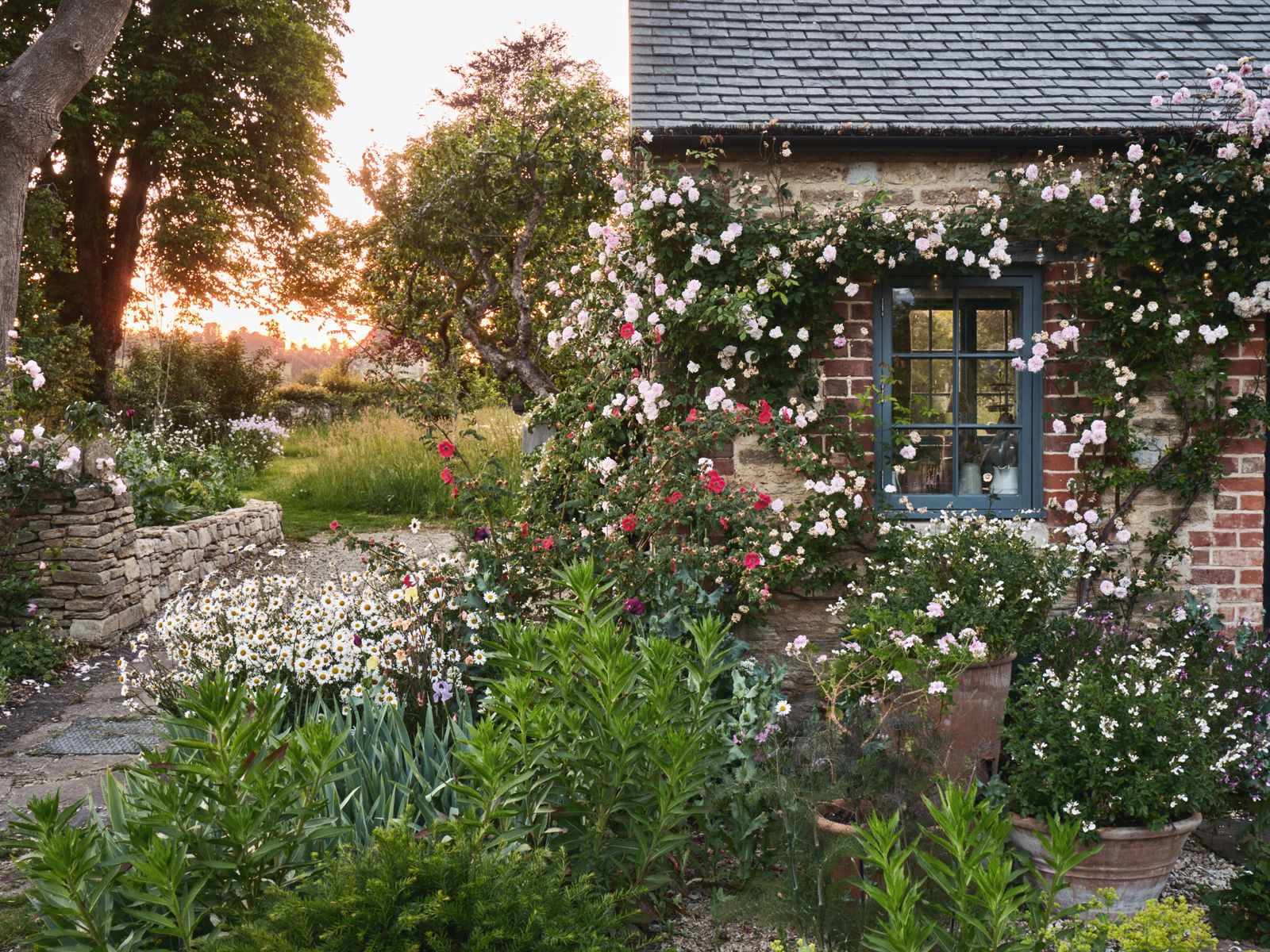
‘I’ve always wanted a courtyard garden, so this is a good stab at it but I didn’t want it to be too structured,’ Catherine says. ‘Everything is self-seeding and soft, and the Erigeron annuus pops up everywhere. The big plant here is acid green Euphorbia wallichii, lasting all season. Other things come and go – there’s a lot of thalictrum, salvias and dark purple geraniums.’ Roses include Portland shrub varieties ‘Comte de Chambord’ and ‘Jacques Cartier’ as well as R. ‘Mutabilis’, which zings against the euphorbia. Unusually, fuchsias – another reminder of home – do well, despite dry conditions.
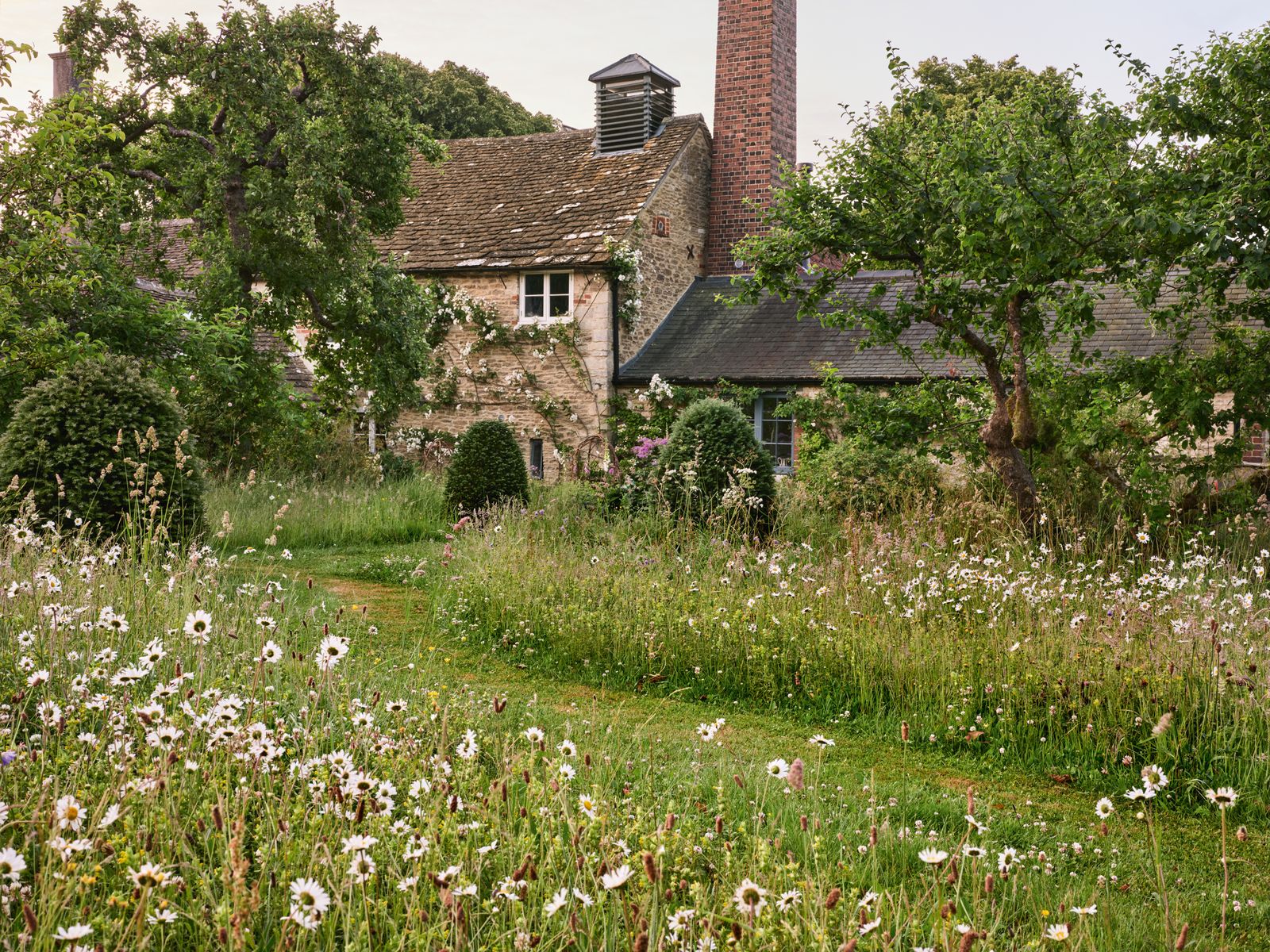
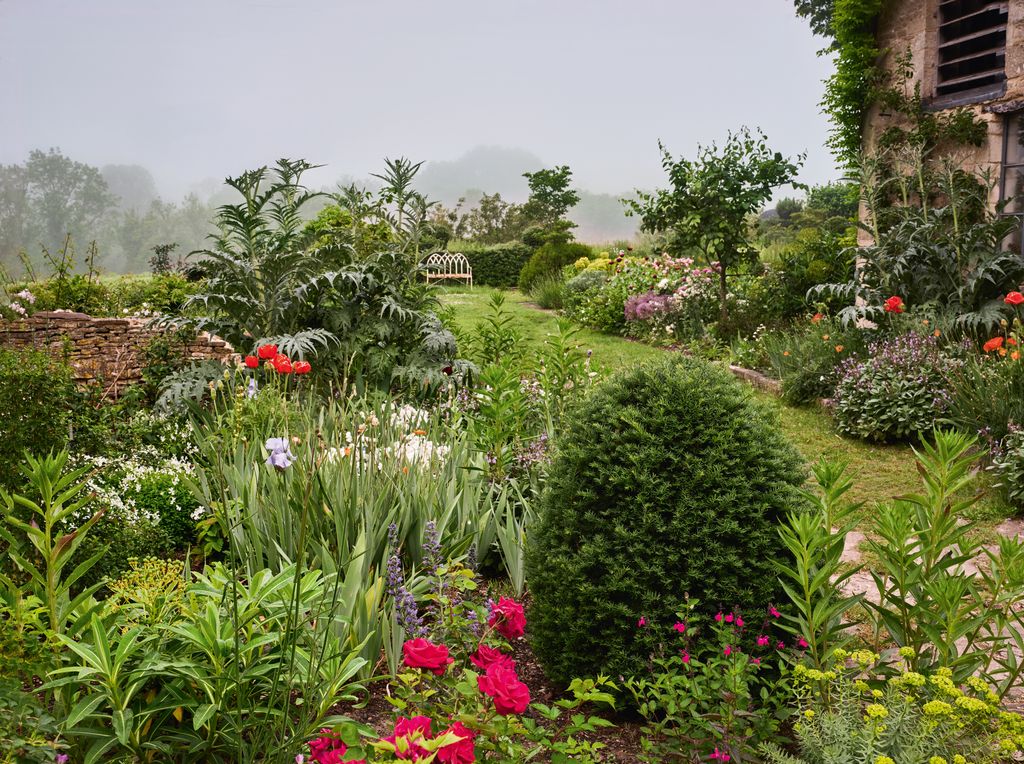
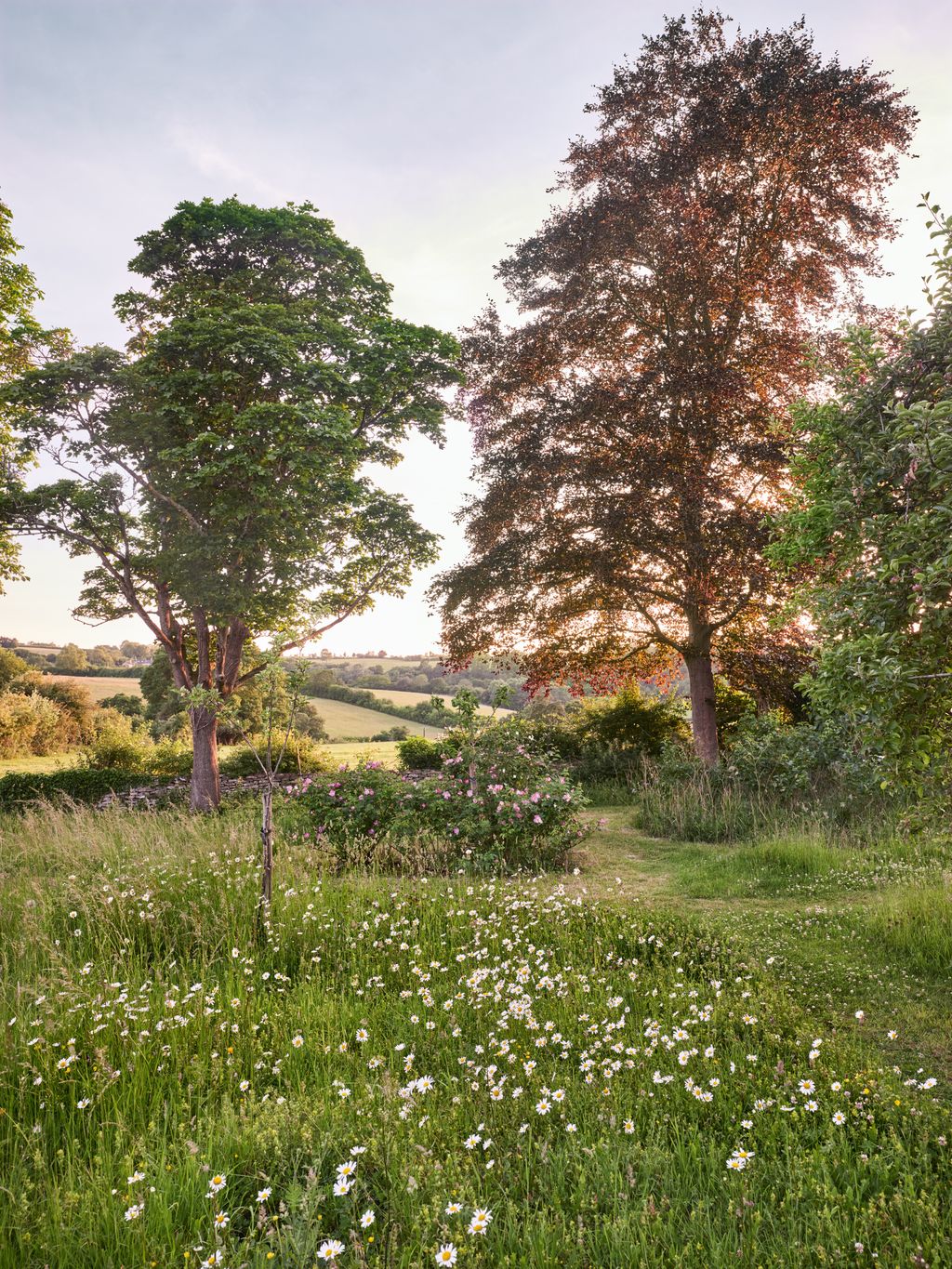
On the far side of the house are beds for herbs and salads and a greenhouse, tucked into a corner of the old orchard, which once had island beds of perennials. In their place, Catherine has planted more apple varieties and created a perennial meadow. On the edges, philadelphus, lilacs and Rosa ‘Complicata’ emerge from the wildflowers and long grass in a relaxed, blowsy way; narcissi planted under the trees kick off the season. She rescued an orange-red oriental poppy growing in a wall here and its progeny provide colour among the silvery leaves of courtyard cardoons and irises.
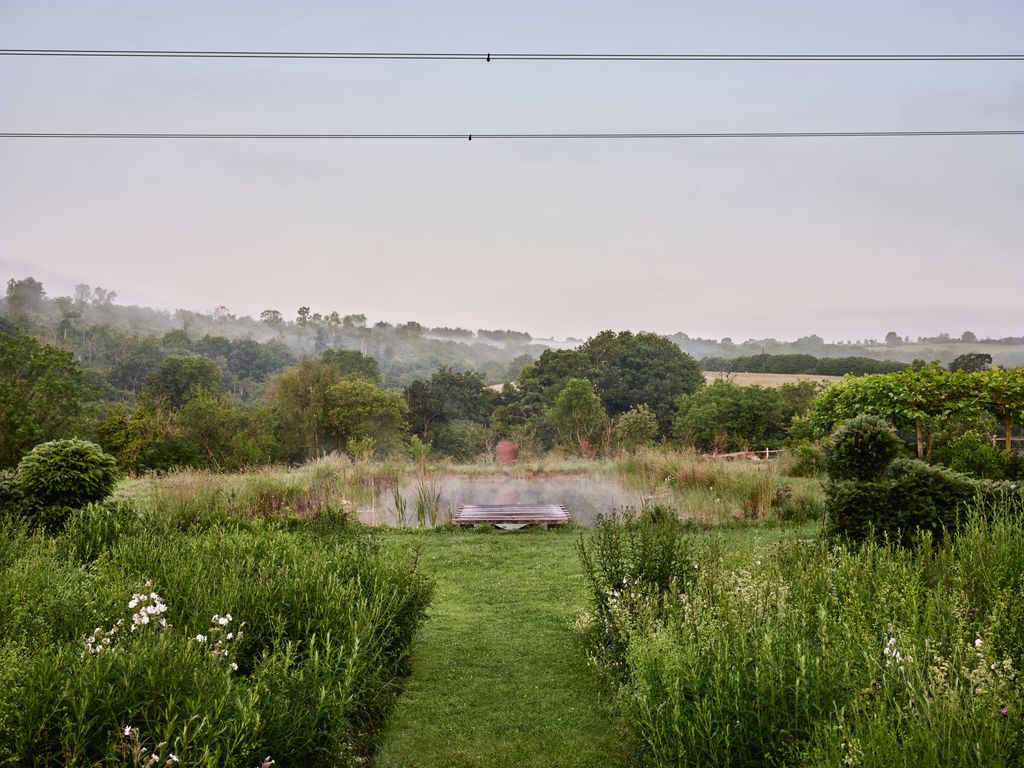
The field beyond the garden is Dominic’s domain, home to his Oxford Sandy and Black pigs, and where he’s developing a wild area around an old rag mill by the river, planting trees and making ponds for wildlife. The couple keep their territories apart, with a swimming pond marking the border between their fiefdoms. Inspired by David Pagan Butler of Organic Pools, it was researched by Dominic and dug with the help of two friends and a digger. It is home to newts and alive with insects and dragonflies, and swallows swoop down to drink in the evening. Surrounded by flag iris and purple loosestrife, it provides a beautiful focal point from the house against the backdrop of the woodland and fields beyond.
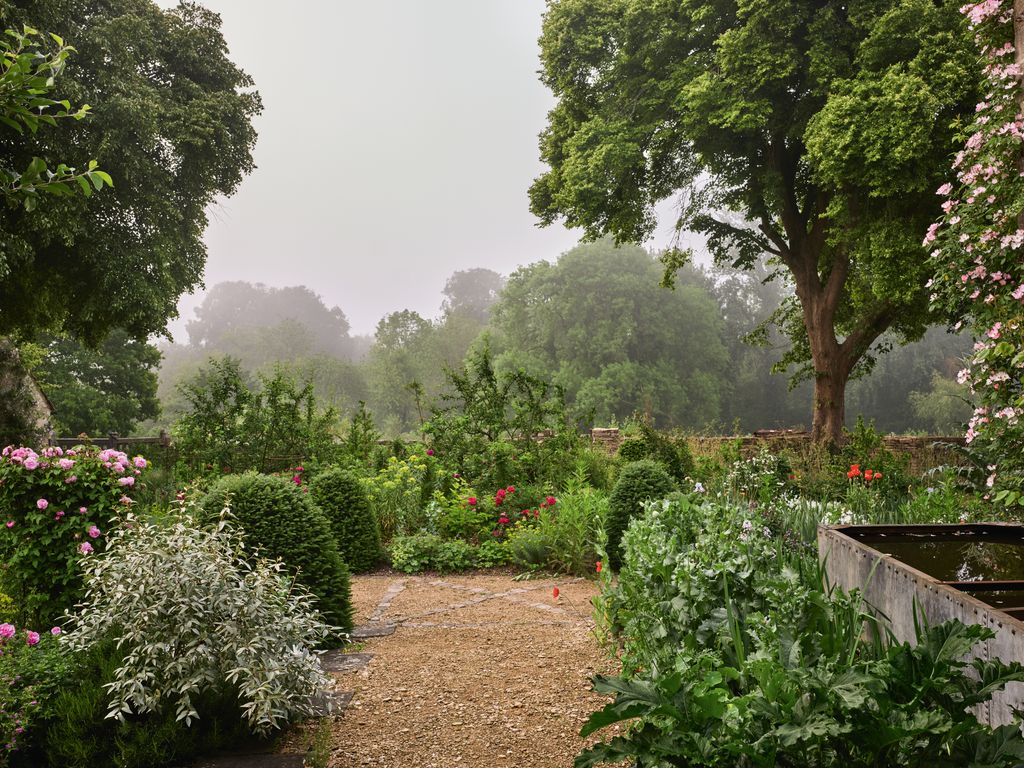
While Catherine has been careful to create a garden that’s very much of its place, she’s allowed herself a small diversion in one shady area – a place to sit in an exotic leafy corner by a calming tank of water. In summer, pots of banana plants are grouped together, a rare fuchsia, banana-leaf cannas and crocosmia strike a different note. With the changing climate perhaps it is a hint of Cotswold gardens to come?
Lutyens & FitzGerald Landscape Design: lutyensfitzgerald.com
 Andrew Montgomery1/5
In the brewery courtyard, Elaeagnus ‘Quicksilver’ contrasts with dark yew beehives, pink Rosa ‘Jacques Cartier’ and Geranium ‘Patricia’.
 Andrew Montgomery2/5
Water for brewery operations was stored in a galvanised zinc tank, which has been made into a pool with water lilies
 Andrew Montgomery3/5
Iris pallida, with its sword-shaped leaves, thrives in the thin soil and contrasts with the distinctive foliage of euphorbias and towering cardoons. Spots of intense colour, in the form of low mauve spheres of Allium cristophii and orangey red oriental poppy ‘Allegro’, punctuate the roses and white dianthus
 Andrew Montgomery4/5
The natural swimming pond is a wildlife haven and provides a focal point from the house, set against woodland and fields beyond.


 Andrew Montgomery5/5
At the orchard’s edge, a copper beech sets off pink Rosa ‘Complicata’ in a wildflower meadow of ox-eye daisies and yellow rattle


